Key takeaways
- In October 2026, Meta unveiled the next generations of Andromeda (ad retrieval) and GEM (the recommendation model that feeds ranking).
- According to Meta, Andromeda evaluates over a billion ads per second, 100 times more than in 2024; GEM reports +18.9% conversions and +12% click-through rate.
- For advertisers, creative becomes targeting: genuinely different concepts open new audiences.
- Anchor Agency’s 8 best practices: diversify concepts, target broadly, simplify structure, clean up the signal, optimize for the real goal, think about the whole journey, refresh then let it learn, measure incrementality.
In October 2026, Meta’s engineering team published two technical articles two weeks apart. The first introduces the next generation of GEM, its ads recommendation model. The second details the next generation of Andromeda, the system that picks candidate ads for each person. Put simply, Meta has just overhauled the two AI systems that decide who sees your ads.
These articles talk about GPUs, mixture of experts and fused kernels. Here is what matters if you invest in Facebook and Instagram advertising, and what we are changing right now in our clients’ accounts.
Figures reported by Meta, Engineering at Meta, 13 and 28 October 2026
How Meta picks the ad you see
Every time someone opens Facebook or Instagram, millions of ads are eligible. Meta cannot evaluate them all in detail within milliseconds, so it works in two stages.
- Retrieval: Andromeda narrows this huge pool down to a short list of relevant candidates for that person.
- Ranking: finer models score each candidate by predicting the likelihood of a click and a conversion. This is where GEM comes in, passing its knowledge on to these models.
Then comes the auction, and delivery in Feed, Stories or Reels.
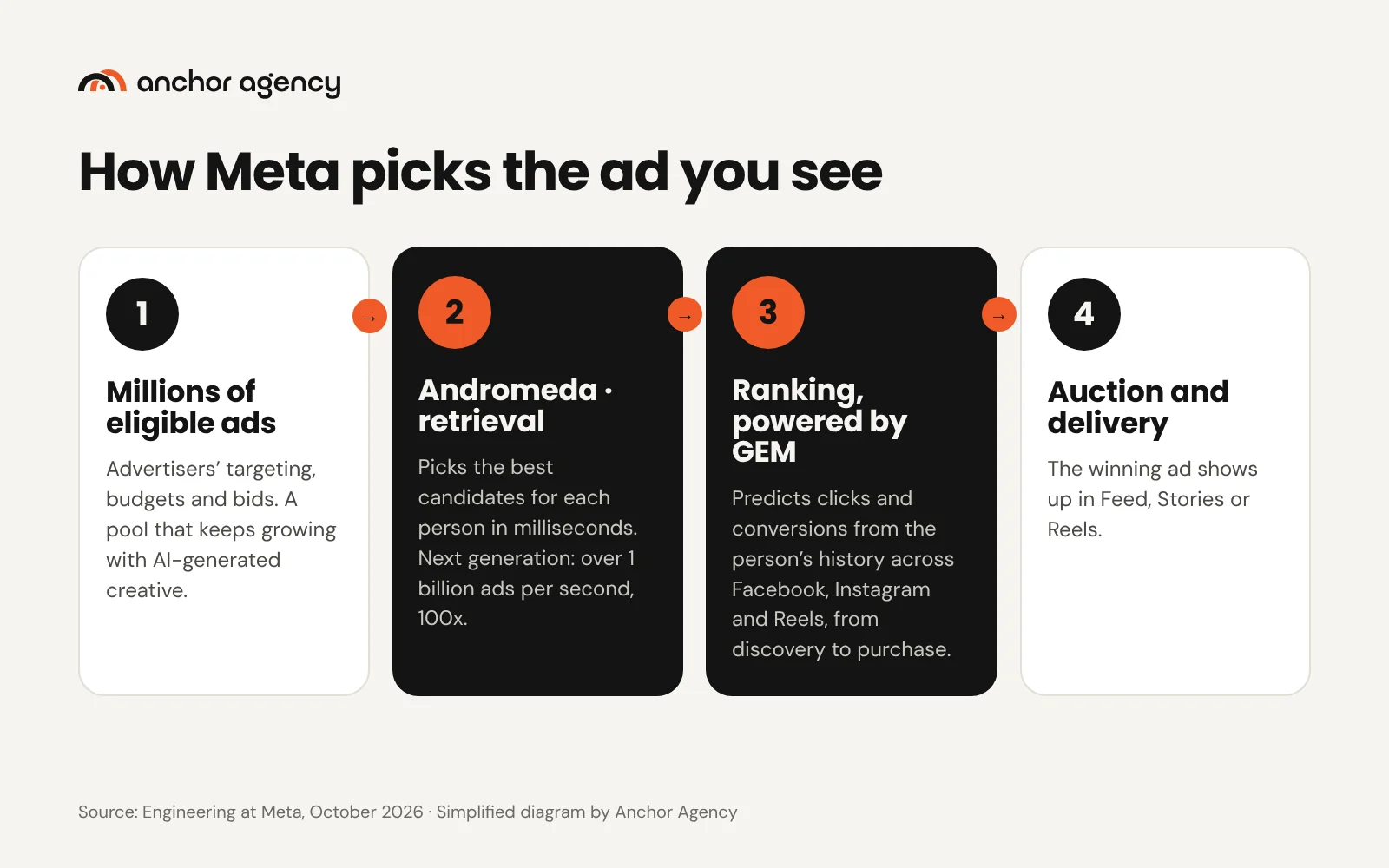
An ad that is not retrieved in the first stage has no chance of being shown, even with a high bid. That is why Andromeda matters so much to advertisers.
Next-generation Andromeda: 100 times more ads evaluated
Launched in December 2024, Andromeda moves to a new architecture. According to Meta:
- the system now evaluates over one billion ads per second in production, 100 times more than in 2024;
- it uses roughly 300 times less compute per prediction, with quality approaching that of ranking;
- instead of a single user model, it combines several specialised “experts”: ad engagement history, similar user cohorts, semantic understanding of content, behaviour across Meta’s apps;
- every ad is assessed in its real-time context.
Why such an effort? Because the number of ads is exploding. Meta says so itself: Advantage+ automation and generative AI creative tools have helped advertisers produce hundreds of millions of new ads. Andromeda can now search this much larger pool for the right ad without slowing down. The reported result: +2.4% conversions on Facebook since 2025.
GEM: one brain for the whole buying journey
Meta describes GEM (Generative Ads Recommendation Model) as the largest recommendation foundation model in the industry. The new version changes three things:
- One model for every surface. Each surface (Facebook, Instagram, Reels) used to have its own models. GEM now learns from all of them at once, and predicts both clicks and conversions, from discovery to purchase.
- A longer memory. GEM uses twice as much behavioural history in production, and Meta has shown it can scale to 25 times more. The bigger the model and the longer the history, the better the predictions.
- A teacher for hundreds of models. GEM is too heavy to score every ad in real time, so it passes what it learns to the hundreds of ranking models that actually serve ads.
Meta reports +18.9% conversions and +12% click-through rate across its surfaces and objectives. Over the past year, GEM delivered +5.8% conversions on Facebook, +4.1% on Instagram and +1.6% off-site for targeted users.
What this changes for businesses and media buyers
These improvements are automatic: there is nothing to switch on. But they shift what separates an average campaign from a profitable one.
1. Your creative is now your targeting
Andromeda matches each ad with the people it is most likely to convince. One idea repeated twenty times in different colours reaches, in practice, one audience. Ten genuinely different ideas (a testimonial, a demo, an offer, a before-and-after, a team video) open ten doors. Targeting now happens mostly in the creative brief.
2. The conversion signal is the fuel
GEM learns from what actually happens after the ad. If your Pixel is poorly set up, if the Conversions API is not connected, or if you optimise for clicks, you are teaching the AI to look for the wrong people. Data quality becomes a competitive advantage.
3. Simple structures win
The more conversions a model gets on one ad set, the faster it learns. Ten ad sets sharing a small budget means ten learning phases that never finish. This is even truer with the budgets we see in Tunisia.
4. The whole journey counts
GEM predicts conversion from a long behavioural history. Someone who watched your video last week and saw a customer proof yesterday is not the same as someone discovering your brand today. Awareness and consideration content therefore feeds sales directly.
The media buyer’s job is changing: less manual audience and bid tweaking, more creative strategy, signal quality, reading results and testing.
8 new best practices to win on Meta
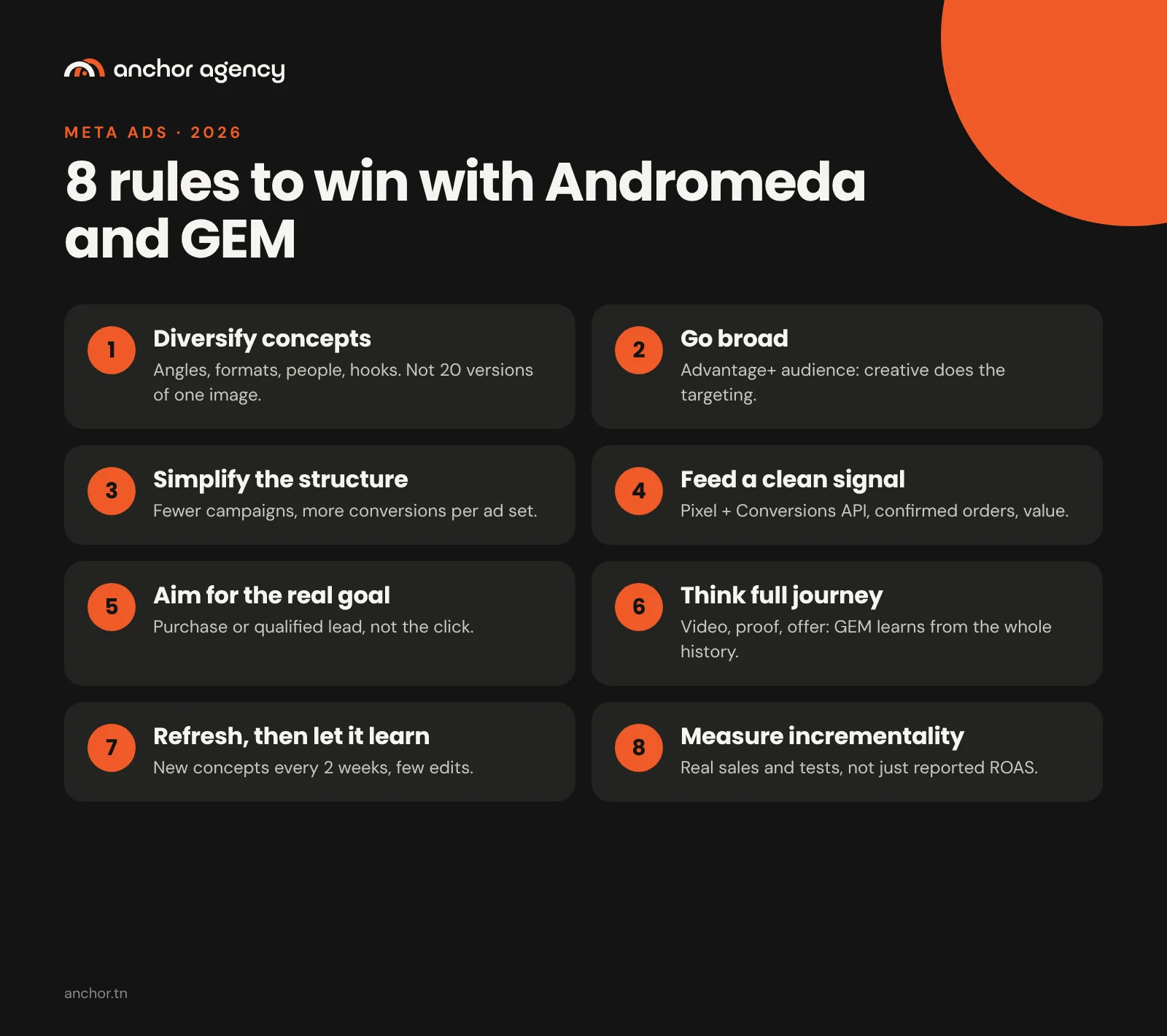
- Diversify concepts, not details. Aim for at least four to six genuinely different ideas per campaign: angles, formats (short video, carousel, image), people on screen, hooks. Stop testing button colours.
- Go broad. Advantage+ audience, or broad targeting by country and age. Keep useful exclusions (recent customers, for example) and let creative do the sorting.
- Simplify the structure. One campaign per objective, few ad sets, enough budget to aim for around fifty conversions per week per ad set where possible.
- Feed a clean signal. Pixel and Conversions API, deduplicated events, purchase value. If you sell cash on delivery, send confirmed orders back to Meta, not just placed orders.
- Optimise for the real goal. Purchase, qualified lead or booking, rather than clicks or page views. The AI finds what you ask it to find.
- Think full journey. Discovery video, proof (reviews, case studies, demos), then the offer. Each step feeds the next.
- Refresh, then let it learn. Add new concepts every two to three weeks, cut those that don’t spend, but avoid editing budgets and ads every day: each change restarts learning.
- Measure incrementality. Compare real sales with reported results, test with and without ads where possible, and don’t judge a campaign on Ads Manager ROAS alone.
What to stop doing
- Stacking interests to reach “the right audience”.
- Duplicating ad sets to “revive” a tired campaign.
- Launching twenty versions of one image and calling it a test.
- Optimising for the cheapest click.
- Killing a campaign after two days.
Our take at Anchor Agency
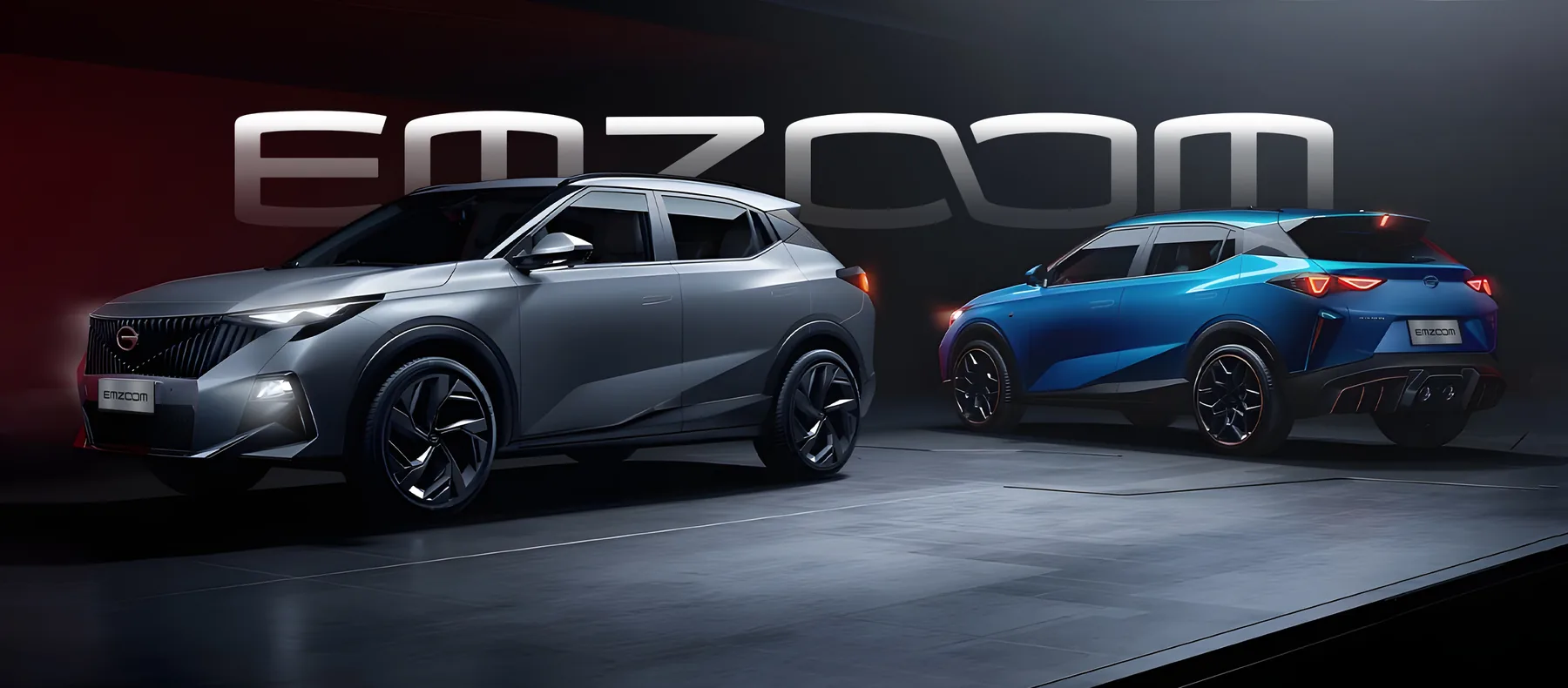
These announcements confirm what we see in the accounts we manage: the campaigns that grow combine real creative diversity, a clean conversion signal and a simple structure. It is the method we applied for GAC Motor, with cost per lead divided by 4.7 in five months.
Meta’s AI will keep improving on its own. What will make the difference is what you feed it: strong creative ideas, reliable data and time to learn.
Update, November 5, 2026: Meta unveiled F3 Lightning, which speeds up how the signals behind these models reach production. Read our article: Meta Ads updates, November 2026: F3 Lightning.
Request my Meta audit
Is your Meta account ready for Andromeda?
We review your creative, your campaign structure and your conversion signal, and you leave with three concrete actions. Free audit, 30 minutes, no commitment.
- Creative diversity and rotation
- Campaign and ad set structure
- Pixel, Conversions API and signal quality
- Three priority actions, reply within 24 working hours
Figures quoted are those reported by Meta (see sources below). Best practices are Anchor Agency’s recommendations.
Frequently asked questions
What is Meta Andromeda?
It is Meta’s system that picks, among millions of ads, the short list of relevant candidates for each person. Its next generation, unveiled on October 28, 2026, evaluates over a billion ads per second according to Meta.
What is GEM at Meta?
GEM (Generative Ads Recommendation Model) is Meta’s large ads recommendation model. It learns from Facebook, Instagram and Reels at once and passes its knowledge to the models that rank ads.
Should you change how you target on Meta?
Yes: target more broadly and let creative do the sorting. Prepare at least four to six genuinely different concepts per campaign rather than variants of the same image.
Do Andromeda and GEM require any setting in Ads Manager?
No, these improvements are automatic. What makes the difference is creative, conversion signal quality and campaign structure.
Sources
Cite this article
Anchor Agency. « Meta Andromeda and GEM: what changes for your ads, and how to win ». anchor.tn, 4 November 2026. https://anchor.tn/en/blog/meta-andromeda-gem-advertising-2026/