Key takeaways
- On November 3, 2026, Meta unveiled F3 Lightning, the new infrastructure that ships the signals (“features”) used by its ads ranking models to production.
- Each signal is now tested and released on its own instead of waiting for all the others: according to Meta, signals reach production about 3.6 times faster, with no increase in compute cost.
- The models that decide who sees an ad on Facebook and Instagram can therefore be improved and retrained more often, following the new versions of GEM and Andromeda announced in October 2026.
- For advertisers, this reinforces two priorities: sending Meta reliable conversion data (pixel, Conversions API, catalog) and producing varied creative.
On November 3, 2026, Meta’s engineering team published a technical article on F3 Lightning, a new layer of its ads infrastructure. It is the third announcement about Meta’s ads AI in a month, after the next generation of GEM and Andromeda in October.
You will not see F3 Lightning in Ads Manager. It works upstream, where Meta builds the data its models use to decide who sees your ad. Here is what it is, what Meta announces, and what we take away for your campaigns.
Figures announced by Meta, Engineering at Meta, November 3, 2026
The three Meta Ads updates of fall 2026
- October 13, 2026
GEM, the ranking brain
One model for Facebook, Instagram and Reels that learns the whole buying journey and passes its knowledge to the ranking models.
- October 28, 2026
Andromeda, ad retrieval
Over a billion ads evaluated per second, 100 times more than in 2024, to find each person’s candidates.
- November 3, 2026
F3 Lightning, the speed of improvement
The signals that feed these models reach production about 3.6 times faster.
The first two announcements change what Meta’s AI can do. The third changes how fast it improves.
What is a signal (“feature”) for Meta’s ads AI?
To predict whether a person will click or buy, a model needs information computed at the moment the ad is served: recent interactions with ads, products viewed over a given window, the type of content watched, the device, the time. Each of these is a feature, a signal.
At Meta, these signals are produced by F3 (Facebook Feature Framework), first presented in 2020. It started with a few hundred signals. According to Meta, a single ad request can now draw on more than 20,000.
The problem: one block for thousands of signals
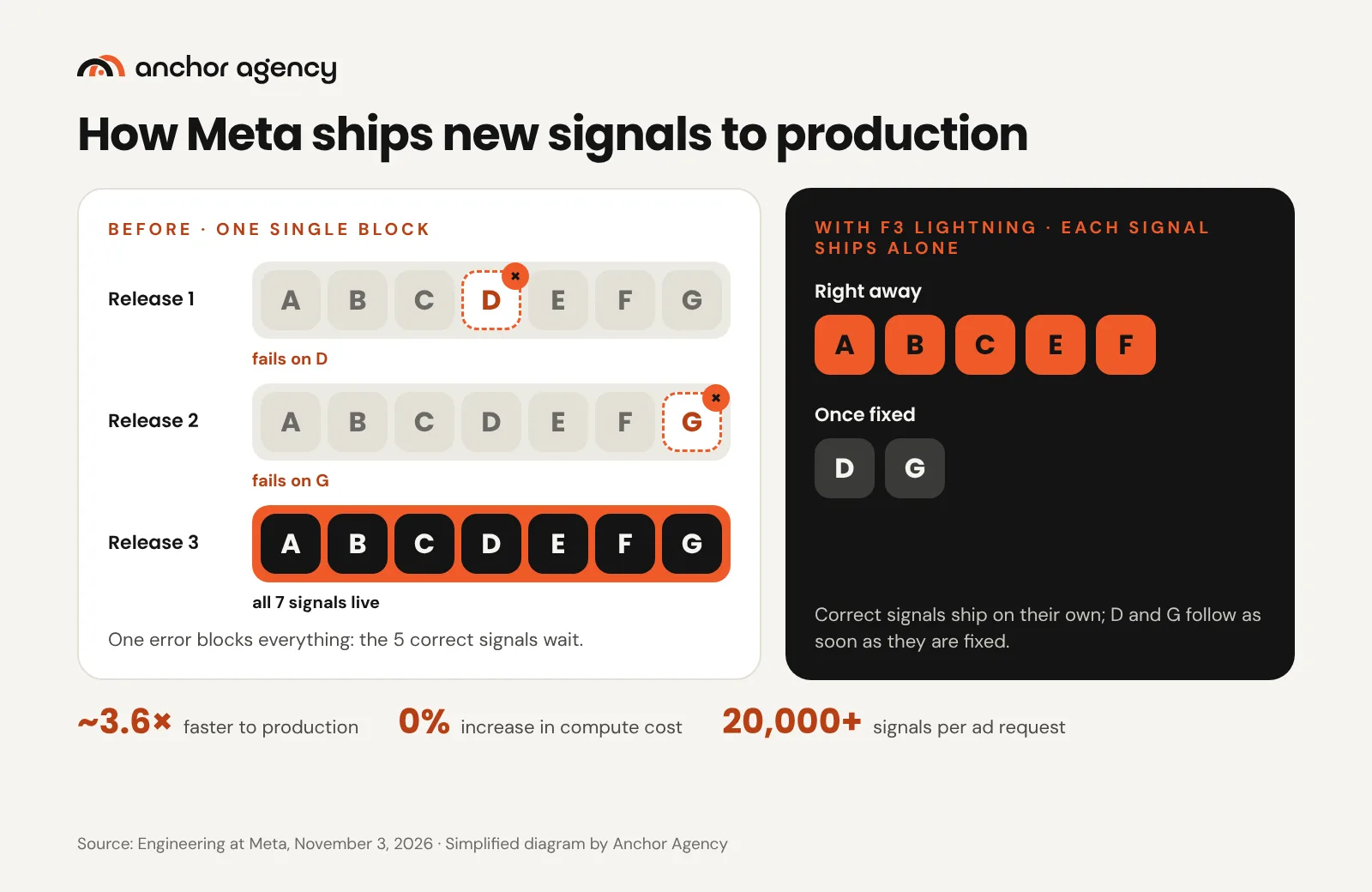
To save compute, F3 merged all signals into one large graph that shipped to production as a single unit. Efficient, but fragile: one error blocked the whole release.
Meta gives an example: seven signals, A to G, are built at the same time. Five are correct, two contain an error. The first release fails on D, the second on G. It takes a third release, after both fixes, for all seven to finally reach production. The five correct signals waited for nothing.
The more signals there were, the more often this happened. And signals already used by live models needed heavier tests, which every other signal had to wait for too.
The fix: each signal ships on its own
F3 Lightning separates two things that used to be tied together: how a signal is released and how it is computed.
- Individual release: each signal is compiled with everything it needs, then tested, deployed and, if needed, rolled back independently. New signals that no model uses yet ship fast; those already read by live models get extra testing.
- Shared computation at startup: to keep the efficiency of the single block, the service finds identical computations across signals at startup, merges them into one execution plan and stores all results in a single memory area. Each computation runs once per request.
- Safety: if a computation fails, only the signals that depend on it are skipped; the others keep working.
What Meta announces, and what it does not say
Meta reports two results:
- comparable signals reach production about 3.6 times faster than with the previous F3;
- no increase in infrastructure compute cost.
The consequence, according to Meta: shorter cycles, so more model iterations in the same period, and models improved and retrained more often.
The article gives no advertiser-side figures: no conversion rate, no cost per result, no revenue impact. What follows is our reading, not a promise from Meta.
What this changes for advertisers
1. Models that evolve faster
The models that rank your ads will receive new signals more often. The platform will learn from user behavior faster, and an account’s performance may move more often than before, up or down.
2. Your data matters even more
A signal is only as good as the data behind it. The events you send (purchases, leads, add-to-carts) and your catalog information are part of what the models learn from. Incomplete or duplicated data teaches the wrong things, faster.
3. The GEM, Andromeda, F3 Lightning continuum
Andromeda picks the candidate ads, GEM helps rank them, F3 Lightning speeds up how both improve. The logic is the same as in our analysis of Andromeda and GEM: creative is your targeting, the conversion signal is your fuel, simple structures win.
4. Well-run accounts get the edge
When the machine improves faster, the gap widens between accounts that feed it good data and varied creative, and those that pile up manual tweaks.
7 best practices to benefit from Meta Ads updates
1. Check your pixel and Conversions API
The pixel alone is no longer enough. Set up the Conversions API, deduplicate events and aim for good match quality in Events Manager.
2. Optimize for the result that really counts
If you sell with cash on delivery, an order placed is not a sale. Where possible, send Meta confirmed orders or qualified leads.
3. Look after your catalog
Clear titles, complete descriptions, up-to-date prices and availability, sharp images. The catalog is a direct source of information for dynamic ads.
4. Produce genuinely different creative
With Andromeda, creative finds its audience. Vary the angles (benefit, social proof, price, founder, use case) and formats, and refresh them every two to three weeks.
5. Keep a simple structure
Fewer campaigns, broad audiences, budgets large enough to exit the learning phase. Splitting a small budget starves the models of data.
6. Read results over 7 days, not one
Models that change more often also mean daily swings. Compare 7-day periods before cutting a campaign or changing strategy.
7. Measure outside Meta
Cross-check Meta’s figures with your store or CRM. For GAC, the cost per prospect, divided by 4.7 in five months, was measured all the way to the dealer’s CRM, not just in Meta.
Request my Meta audit
Is your Meta account sending the right signals?
We check your pixel, Conversions API, catalog and creative, and you leave with three concrete actions. Free audit, 30 minutes, no commitment.
- Signal quality: pixel, Conversions API, events
- Product catalog and data sent to Meta
- Creative diversity and rotation
- Three priority actions, reply within 24 working hours
Frequently asked questions
What is F3 Lightning?
It is a Meta infrastructure layer, unveiled on November 3, 2026, built on F3 (Facebook Feature Framework). It lets each signal used by the ads models be tested and shipped to production independently, while keeping computation shared.
Does F3 Lightning change anything in Ads Manager?
No, nothing visible. F3 Lightning works inside Meta’s infrastructure. Its effect is indirect: the models that rank ads can be improved more often.
Will my results improve automatically?
Meta publishes no advertiser-side figures for F3 Lightning. Models that improve faster mainly benefit accounts that send reliable conversion data and varied creative.
How does it relate to Andromeda and GEM?
Andromeda retrieves candidate ads, GEM helps rank them, and F3 Lightning speeds up the release of the signals that feed these models. All three announcements date from October and November 2026.
What should I do first on my account?
Check signal quality (pixel, Conversions API, deduplicated events), then creative diversity. If your budget is tight, start with our guide to Meta Ads budgets in Tunisia.
Our take at Anchor Agency
In one month, Meta renewed how ads are retrieved, how they are ranked, and how fast all of it improves. The message for advertisers does not change, it gets stronger: give the machine good data and good creative, then let it work.
That is what we apply in our clients’ accounts, from Meta & Google Ads management to peak-season campaigns, as with Miravella’s Black Friday.
Sources
Cite this article
Anchor Agency. « Meta Ads updates, November 2026: F3 Lightning speeds up Meta’s ads AI ». anchor.tn, 5 November 2026. https://anchor.tn/en/blog/meta-ads-updates-november-2026-f3-lightning/