Key takeaways
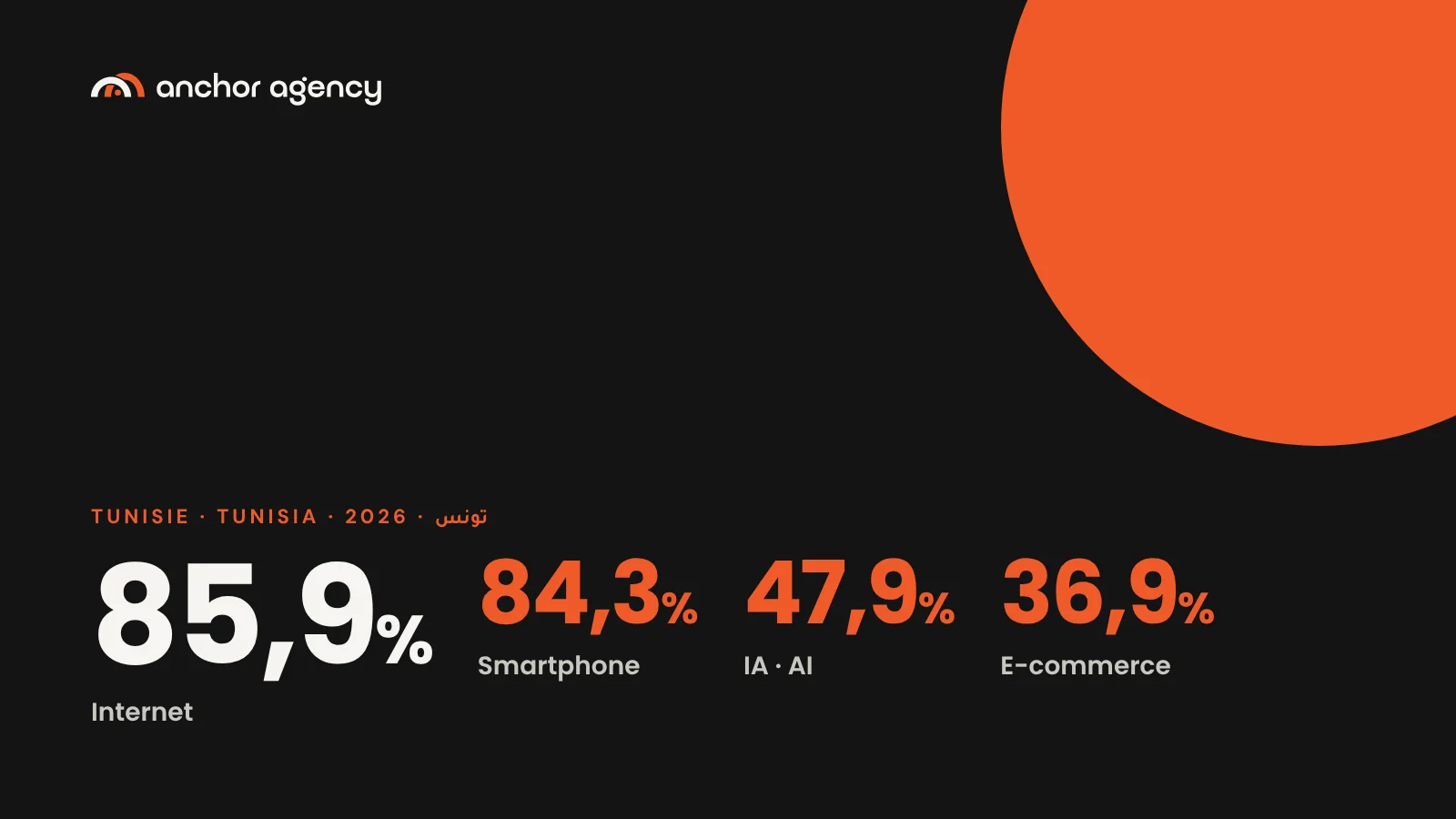
- According to the 2026 Digital Barometer of Tunisia’s National Telecommunications Authority (INT), 85.9% of Tunisians aged 10 to 70 use the internet and 95.4% use a mobile line.
- 84.3% own a smartphone, compared with 41.0% who own a computer: Tunisia is a mobile-first market.
- Among internet users, 47.9% use artificial intelligence and 36.9% shop online, i.e. about 41% and 32% of 10-to-70-year-olds (Anchor Agency calculation).
- Income creates a gap: 72.6% own a smartphone below 600 TND of monthly income, versus 96.6% from 2,500 TND.
- For brands: mobile-first websites and ads, vertical video, visibility in AI assistants, and reassuring purchase journeys to convert e-commerce.
Tunisia’s National Telecommunications Authority (INT) has published the results of its 2026 Digital Barometer. It is one of the most complete pictures of digital habits in Tunisia: 5,077 people aged 10 to 70, interviewed face to face from May 15 to June 10, 2026 by a specialist firm, on a sample representative of the population.
We gathered the key figures, then read them through a marketer’s lens: who is connected, on which device, to do what, and what it means for a brand that wants to sell in Tunisia.
INT, 2026 Digital Barometer, survey from May 15 to June 10, 2026
Key figures of the 2026 Digital Barometer
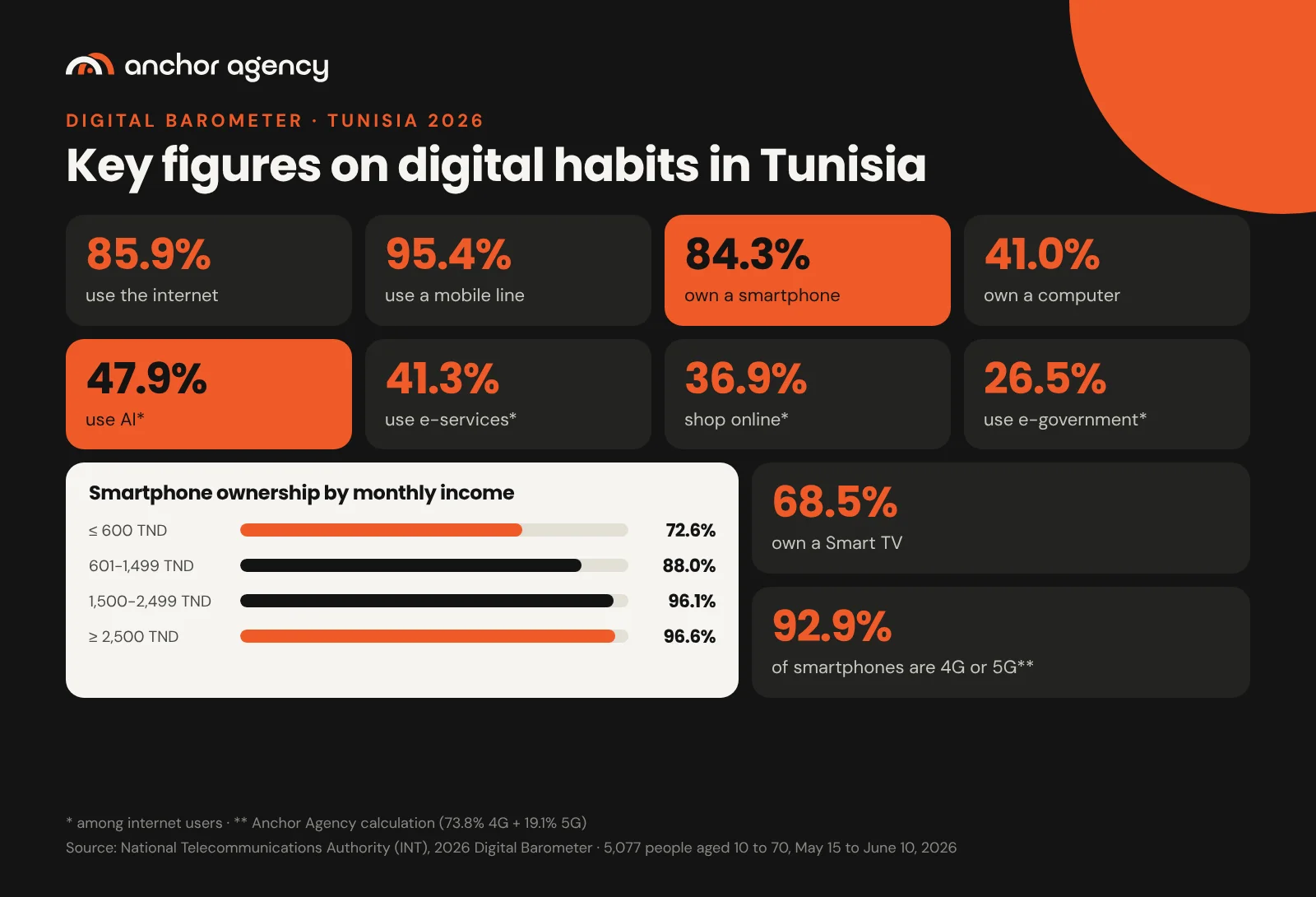
- Internet: 85.9% of 10-to-70-year-olds use it. Of these, 70.4% use mobile internet.
- Mobile telephony: 95.4% use a mobile line, 96.5% own at least one phone.
- Smartphone: 84.3% of 10-to-70-year-olds own one; that is 87.4% of people who own a phone.
- Computer: 41.0% own one (36.6% a laptop, 10.1% a desktop).
- Digital services, among internet users: artificial intelligence 47.9%, e-services 41.3%, e-commerce 36.9%, e-government 26.5%.
- Home screens: 68.5% have a Smart TV, 68.3% a digital receiver, 17.8% a smartwatch, 12.5% a tablet.
What is the INT Digital Barometer?
It is a survey by the Observatory of the INT, Tunisia’s telecommunications regulator. The 2026 edition used the CAPI method (tablet-based face-to-face questionnaire) on a representative sample of the Tunisian population aged 10 to 70. A first part on internet use and digital skills was published in July 2026; the detailed part on mobile telephony and equipment followed in November 2026.
How many Tunisians use the internet and mobile in 2026?
85.9% of 10-to-70-year-olds use the internet and 95.4% use a mobile line. Mobile is the gateway: according to figures reported by Tuniscope, 70.4% of internet users connect via mobile, versus 65.3% via a fixed connection, and fiber still reaches only 4% of them.
The phone reaches every generation. Mobile line use exceeds 97% between 18 and 54, and stays at 94.2% among 60-to-70-year-olds.
- 10 to 1784.8%
- 18 to 2497.3%
- 25 to 3499.1%
- 35 to 4498.4%
- 45 to 5498.1%
- 55 to 5996.9%
- 60 to 7094.2%
Source: INT, 2026 Digital Barometer
Men and women are on par (95.8% and 95.1%). Education matters more: 99.4% of university graduates use a mobile line, versus 88.9% of people who never went to school. Finally, 20% of users have at least two lines, often to benefit from several operators’ offers.
Smartphones: a mobile-first market
84.3% of 10-to-70-year-olds own a smartphone, twice as many as computer owners (41.0%). The vast majority (88.2%) have a single phone.
These smartphones are recent: 73.8% are 4G-compatible and 19.1% 5G-compatible, i.e. 92.9% able to play video comfortably (Anchor Agency calculation). Basic phones are still around (14.3% of phone owners), but they are mostly 2G or 3G.
Income and region widen the gap
Smartphones are almost universal among working people (92.1%, and 98.5% in telecom and digital jobs), but drop to 82.8% among people not in work. The sharpest gap comes from income.
- 600 TND or less72.6%
- 601 to 1,499 TND88.0%
- 1,500 to 2,499 TND96.1%
- 2,500 TND and more96.6%
Source: INT, 2026 Digital Barometer
Below 600 TND of income, 29.0% still own a basic phone, six times more than above 2,500 TND (4.8%). Regional gaps exist too: smartphone ownership ranges from 82.3% in district 1 to 93.0% in district 5, according to the INT’s breakdown.
AI, e-commerce, e-government: what internet users do
- Artificial intelligence47.9%
- E-services41.3%
- E-commerce36.9%
- E-government26.5%
Source: INT, 2026 Digital Barometer
Applied to all 10-to-70-year-olds, these rates give about 41% AI users, 32% online shoppers and 23% e-government users (Anchor Agency calculation: internet use rate × rate among internet users).
The most striking figure is AI: nearly one internet user in two already uses it, more than e-commerce. Assistants such as ChatGPT, Gemini or Meta AI are becoming a new entry point to find information, compare offers or choose a provider.
Smart TVs and connected devices: the screens at home
68.5% of respondents have a Smart TV and 68.3% a digital receiver. The big screen is connected: YouTube and streaming platforms are watched there as much as traditional TV. Smartwatches (17.8%) and tablets (12.5%) remain a minority.
Our analysis: what these figures change for brands
1. Design for the smartphone first
With 84.3% smartphones and 41.0% computers, most of your customers discover your brand, visit your website and fill in your forms on a phone. A slow website or a clumsy mobile form loses sales before the ad has even done its job. That is the starting point of our websites and e-commerce work.
2. Bet on vertical video
92.9% of smartphones are 4G or 5G. Reels, Stories and short videos are this audience’s natural format. For Miravella, two videos of the founder generated 85% of purchases attributed to Meta during Black Friday 2025.
3. Show up in AI assistants’ answers
When 47.9% of internet users use AI, being cited in its answers matters as much as Google. That takes clear, dated, sourced and structured content, like this article. It is the purpose of our SEO and AI visibility service.
4. Convert e-commerce through trust
36.9% of internet users shop online: the potential is real, but many still hesitate. Cash on delivery, advice on WhatsApp, visible customer reviews and clear delivery times reassure buyers and get them to order.
5. Adapt the message to income and region
A 24-point smartphone gap between the lowest and highest incomes changes targeting, offers and entry prices. For a mass-market product, test different messages and offers by region rather than a single national campaign.
6. Don’t forget the over-55s
96.9% of 55-to-59-year-olds and 94.2% of 60-to-70-year-olds use a mobile line. Health, real estate, banking, cars: this audience is reachable on Facebook and WhatsApp, as long as you speak to them simply.
7. Think about the big screen
With 68.5% of homes owning a Smart TV, YouTube is also a family screen. A well-produced video can play on the phone in the morning and on the TV in the evening, for a budget nowhere near TV advertising.
What we recommend
- Audit your mobile journey: loading speed, readability, form, WhatsApp button.
- Plan regular video production, in vertical format, with real faces and real proof.
- Structure your content for Google and AI assistants: clear answers, dated figures, sources.
- Send good signals to your ad platforms: since the latest updates, Meta’s AI learns faster from your data (see our articles on F3 Lightning and Andromeda and GEM).
- Size your budget to your goal: our guide to Meta Ads budgets in Tunisia gives you benchmarks, and you can estimate your budget online.
Request my audit
Is your marketing ready for these habits?
We review your website on mobile, your visibility on Google and in AI assistants, and your campaigns. You leave with three concrete priorities. Free audit, 30 minutes.
- Website and forms tested on smartphone
- Visibility on Google and in AI assistants
- Content and ads built for mobile
- Three priorities, reply within 24 working hours
Frequently asked questions
How many Tunisians use the internet in 2026?
According to the INT’s 2026 Digital Barometer, 85.9% of Tunisians aged 10 to 70 use the internet. The survey covered 5,077 people from May 15 to June 10, 2026.
What is the smartphone ownership rate in Tunisia?
84.3% of 10-to-70-year-olds own a smartphone. Among people who own a phone, 87.4% have a smartphone; 73.8% of these smartphones are 4G-compatible and 19.1% 5G-compatible.
How many Tunisians shop online?
36.9% of internet users use e-commerce, i.e. about 32% of 10-to-70-year-olds given that 85.9% use the internet (Anchor Agency calculation).
Do Tunisians use artificial intelligence?
Yes: 47.9% of internet users say they use AI, about 41% of 10-to-70-year-olds. That is more than e-commerce (36.9%) and e-government (26.5%).
Who carried out the 2026 Digital Barometer?
The Observatory of Tunisia’s National Telecommunications Authority (INT), with a specialist firm, using a face-to-face questionnaire (CAPI method) on a representative sample of the Tunisian population aged 10 to 70.
What should brands do with these figures?
Design for the smartphone first, produce vertical video, work on their visibility on Google and in AI assistants, and reassure online buyers. You can request a free audit to know where to start.
Figures are those published by the INT. Derived calculations are marked “Anchor Agency calculation”. The analysis and recommendations are Anchor Agency’s.
Sources
- National Telecommunications Authority (INT), Observatory: 2026 Digital Barometer, use of mobile telephony and telephone and technology equipment, November 2026
- National Telecommunications Authority (INT), 2026 Digital Barometer: internet use and digital skills, July 2026
- Tuniscope, “Internet en Tunisie : le mobile domine avec 70,4 % des connexions”, September 25, 2026
Cite this article
Anchor Agency. « Tunisia Digital Barometer 2026: key figures and what they mean for brands ». anchor.tn, 20 November 2026. https://anchor.tn/en/blog/tunisia-digital-barometer-2026-key-figures/
Follow Anchor Agency on Google
Add anchor.tn to your preferred sources: our articles and marketing advice will show up first in your Google results.
Add as a preferred source on Google